
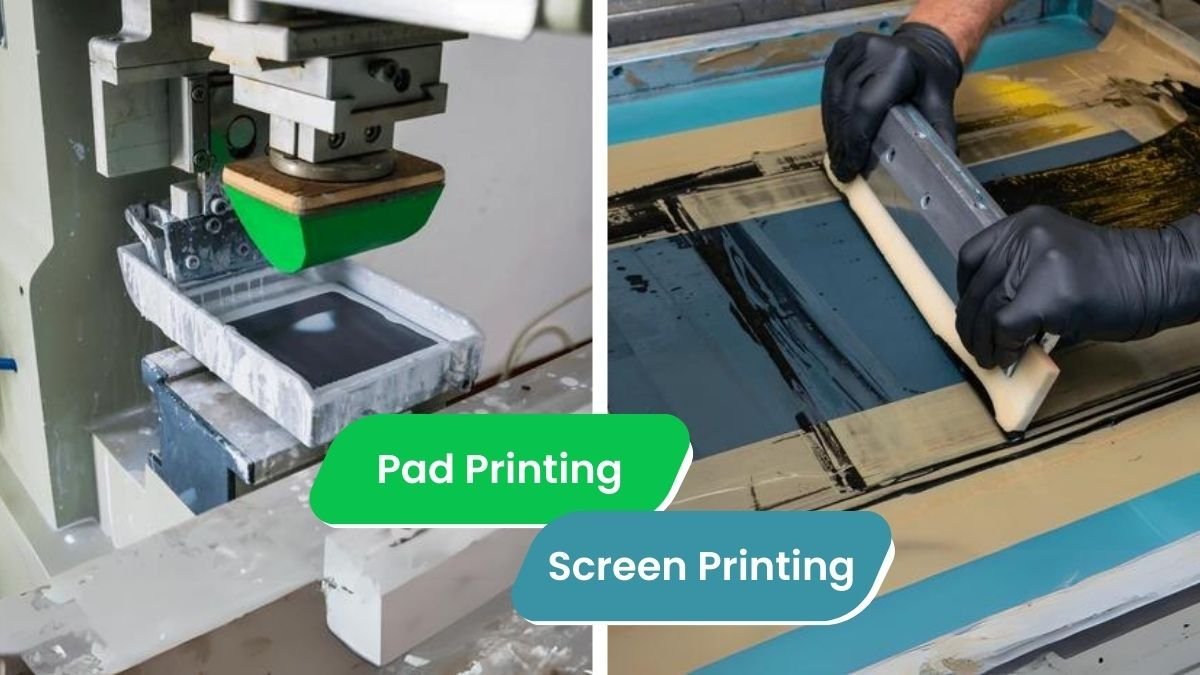
If you’re getting your logo printed on a product, you’ll often hear both names. Both methods put your design on the product, but they suit very different surfaces, quantities and designs.
We’ve been printing in Mumbai since 1999 and run both methods in our workshop. This guide explains how each one works, compares them side by side, and ends with a simple way to choose.
The short answer
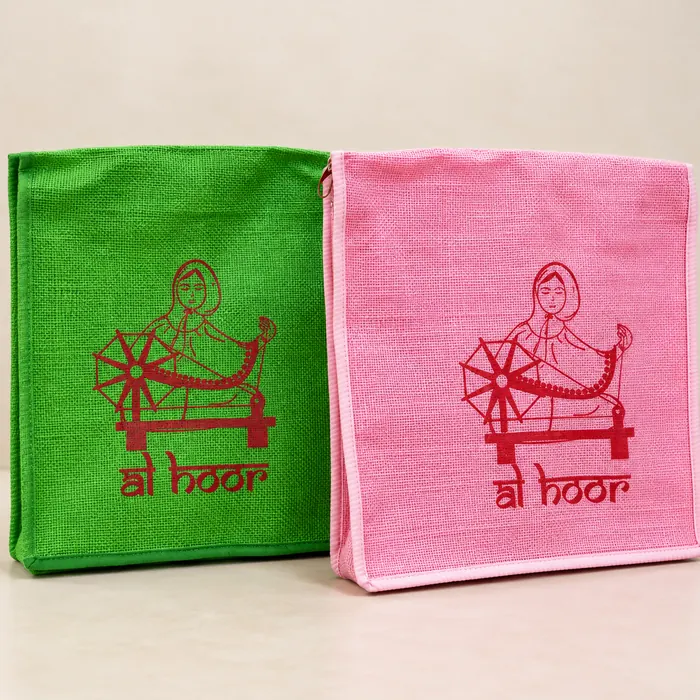
Screen printing pushes ink through a mesh stencil onto a flat surface. It’s quicker and cheaper to set up, and gives bold, solid colour on bags, T‑shirts, boxes and panels.
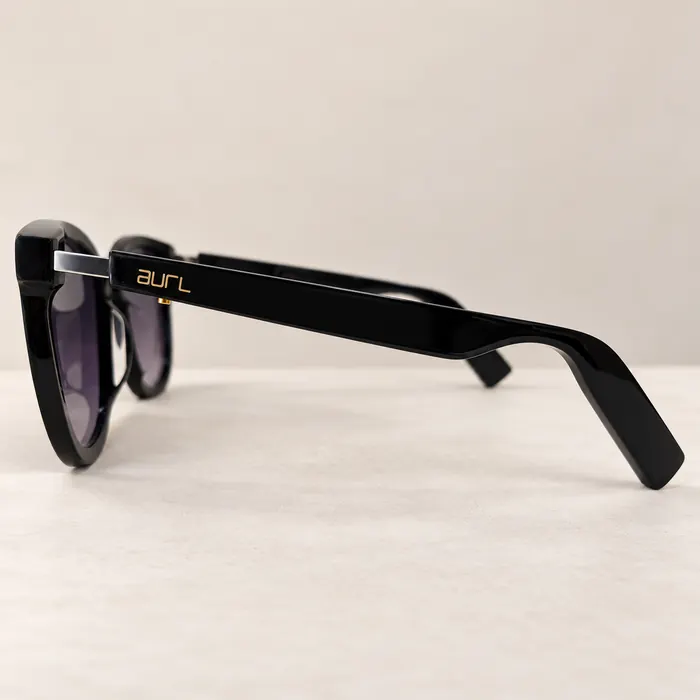
Pad printing lifts your design off an etched plate with a soft silicone pad and presses it onto the product. The pad bends around curves, so it prints in fine detail where a screen can’t reach: sunglasses arms, balls, switches, pens and small electronic parts.
The rule of thumb: flat print area, screen printing. Curved, textured or tiny print area, pad printing. Round products like bottles and mugs use a third method, round printing.
What is pad printing?
Pad printing, also called tampo printing, transfers a flat design onto a three-dimensional product. Think of it as a very precise rubber stamp: a soft silicone pad picks up ink from an engraved plate and presses it onto the product.
Because the pad is soft, it wraps around curves, reaches into recesses and sits evenly on textured surfaces. That’s how a brand name ends up crisp on the curved arm of a pair of sunglasses, or a signature on a tennis ball.
It’s the most precise of the three methods we offer, and the usual choice for electronics, small parts and promotional items. See what we print on our pad printing services page.
How pad printing works
Every pad printing job follows the same five steps.
- The plate is made. Your design is etched into a metal plate as a pattern of shallow grooves.
- The plate is inked. Ink floods the plate, then a blade wipes the surface clean, leaving ink only in the grooves.
- The pad picks up the design. The silicone pad presses down on the plate and lifts the ink out of the grooves.
- The pad prints the product. It presses onto the product, flexes to its shape and leaves the design behind.
- The ink cures. The print dries or is cured so it bonds to the surface and stands up to handling.
Each colour needs its own plate and its own pass, which is why pad printing is usually kept to one or two colours.
What is screen printing?
Screen printing pushes ink through a fine mesh screen onto the product. A stencil blocks most of the screen, so ink only passes through where your design is.
Screen printing lays down a thick, opaque layer of ink, so colours stay bold even on dark materials. It’s the quickest and most affordable of our methods for flat print areas. See our screen printing services.
How screen printing works
A screen printing job takes four steps.
- The screen is made. The mesh is coated with a light-sensitive emulsion and exposed with your design. The emulsion hardens everywhere except the design, which washes out as open mesh.
- The screen is lined up. It’s fixed above the product so the design lands in exactly the same place on every piece.
- Ink is pulled across. A rubber blade called a squeegee drags ink over the screen with even pressure, pushing it through the open mesh onto the product.
- The print dries. The ink is air dried, heat dried or UV cured, depending on the ink and the material.
A design in several colours gets one screen per colour, each printed in line with the one before.
Pad printing vs screen printing, side by side
The same ten questions, answered for both methods.
| Pad printing | Screen printing | |
|---|---|---|
| Print surface | Curved, concave, textured or uneven | Flat, or very gently curved |
| Print area | Small: logos, labels, short text | Small to large |
| Fine detail | Very fine lines and tiny text | Clean, bold lines; tiny text is harder |
| Colour | Usually one or two colours, thin ink layer | Bold, opaque colour, several colours possible |
| Setup | Etched plate per colour, costlier ink | One screen per colour, quicker to set up |
| Small orders | Higher cost per piece | Most affordable; minimum order 10 to 20 pieces |
| Large orders | Best value, setup shared across more pieces | Cost per piece drops further |
| Speed | Slower on complex shapes | Fast once the screen is set up |
| Durability | Bonds well, stands up to daily handling | Thick ink, wears well on fabric and flat items |
| Typical products | Sunglasses, switches, USB drives, balls, pens | Bags, T‑shirts, jackets, boxes, yoga mats |
The differences in detail
Surface: usually the deciding factor
Start with where your design will go, because that often decides the method on its own.
A screen has to sit close to a flat print area. On a curve, the mesh can’t touch the whole design and the print breaks up. The silicone pad has no such limit: it changes shape as it presses down, so it prints evenly on convex and concave surfaces, edges, textures and recesses.
Detail and colour
Pad printing holds very fine lines and small text cleanly, which is why it’s used for switch labels, control panels and tiny logos on electronics. The ink layer is thin, so it works best in one or two colours.
Screen printing lays a thicker layer of ink. Colours look bold and opaque, even white on a dark bag, and several colours can be printed one after another. Hairlines and very small text are harder to hold with a mesh.
Setup and cost
Both methods have a fixed setup cost for each design: a screen for screen printing, an etched plate and costlier ink for pad printing. That cost is shared across the order, so bulk orders cost less per piece with either method.
The difference is the size of the setup. Screen printing is quicker and cheaper to set up, so it suits short runs. Pad printing’s higher setup makes it the better value on larger quantities. Price depends on quantity, colours and the product, so send your requirements and we’ll talk it through.
Speed on large orders
Once the screen is set up, screen printing moves quickly, which is why it’s used for large runs of bags and garments. Pad printing is slower on complex shapes because each colour is a separate pass, but on many curved products it’s the only one of the two that can do the job. Either way, we agree the deadline with you before we start.
How long the print lasts
Both give a lasting print when the ink is matched to the material. Pad printing ink bonds well to plastic, metal and glass, so it’s used on buttons, switches and tools that are handled every day. Screen printing’s thicker ink wears well on fabric, bags and flat products.
You see the result before you commit: we print your design on 2 or 3 of your own pieces, and you approve the sample before the full order.
Which should you choose?
Look at the spot where your design will go, then check it against these two lists.
Choose pad printing if
- The print area is curved, concave or textured
- Your logo or text is small or very detailed
- The product is a small part: electronics, switches, pens, sunglasses
- You’re ordering a larger quantity
Choose screen printing if
- The print area is flat
- You want bold, solid colour, also on dark materials
- The design is large or has several colours
- You need a short run, from 10 to 20 pieces
What about mugs, bottles and other round products?
Neither is the usual choice for a mug, glass, bottle or flask. Round products go on round printing, a kind of screen printing where the product turns under the screen, so the design wraps evenly all the way around. Pad printing still helps when the logo is small or sits on a curved part like a lid or handle. See round printing services and bottle printing in Mumbai.
Pad and screen printing questions
Which method is faster for a large order?
Usually screen printing. Once the screen is ready, each piece takes one quick pass. Pad printing prints each colour separately, so it takes longer on complex shapes, but it is often the only option for curved parts.
Which is cheaper, pad printing or screen printing?
For most jobs, screen printing, especially on small orders, because its setup is quicker and cheaper. Pad printing needs an etched plate and costlier ink, so it works out best on larger quantities. With both methods, the more pieces you print, the less each one costs.
Can pad printing print more than one colour?
Yes. Each colour gets its own plate and is printed in a separate pass, lined up with the one before. Because every extra colour adds setup, pad printing is usually kept to one or two colours.
Can you screen print on a curved surface?
Not well on tight or uneven curves, because the screen can’t touch the whole design. Cylindrical products like bottles and mugs go on round printing, and curved or textured parts go on pad printing.
Which print lasts longer?
Both last well when the ink is matched to the material. Pad printing is often chosen for parts that are handled every day, like switches and buttons. Screen printing’s thick ink layer holds up well on fabric and bags.
How do I know which method my product needs?
Send us a photo of the product and the design on WhatsApp, and we’ll tell you which method fits. Before the full order, we print a sample on 2 or 3 of your own pieces for you to approve.